
Goldmund’s Education in Mortality
Narcissus and GoldmundEncounters with death transform Goldmund’s response to violence, beauty, and creative work, making mortality both a terror and a source of artistic insight.
increasing Bearing strength in each event
 decreasing
Bearing strength in each eventdecreasingThe First Fear of Death
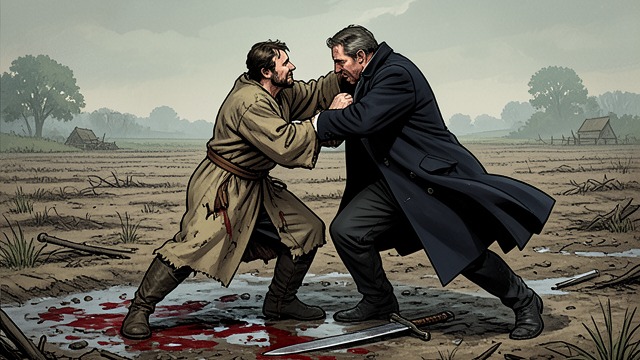
The First Fear of Death
Violence at Close Quarters
Viktor’s attack forces Goldmund to fight with the prospect of immediate death before him. He survives by killing his assailant rather than by relying on shelter or authority.
A Mark That Remains
The episode leaves guilt and a lasting awareness of bodily vulnerability. Goldmund’s later curiosity about death grows from having once faced it as an enemy.
Seeing the Dead Family
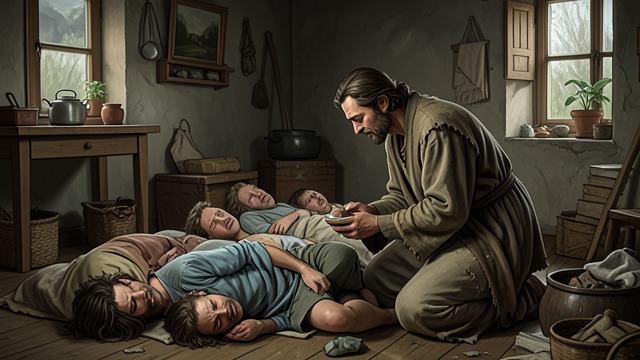
Seeing the Dead Family
Death at Home
Goldmund discovers a whole family dead in a deserted farmhouse. He studies their positions and expressions rather than fleeing from the scene.
The Artist’s Attention
His response combines compassion with an almost involuntary observation of form. Death becomes something he must understand through the visible traces it leaves on bodies.
Life Beside the Death Cart
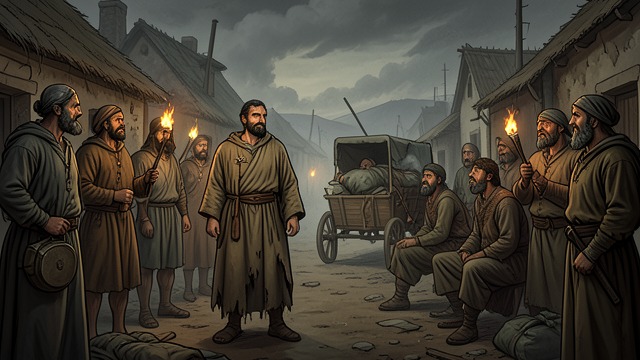
Life Beside the Death Cart
Public Catastrophe
Goldmund witnesses mass burials, abandoned homes, and the collapse of ordinary protections. He sees communities turn toward scapegoating and violence as fear spreads.
A Changed Understanding
His attention to death is no longer limited to individual loss. He encounters a social world warped by terror, where survival can coexist with cruelty and moral failure.
Lene’s Dying
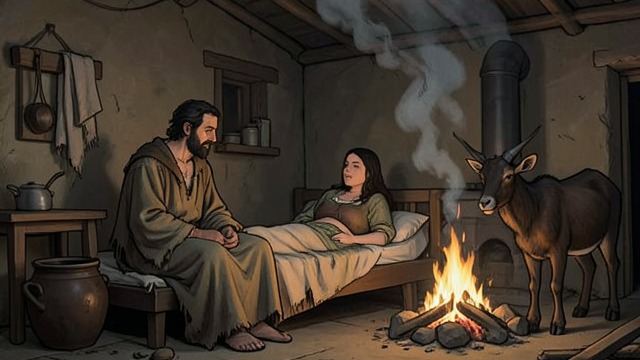
Lene’s Dying
Care Without Escape
Goldmund stays beside Lene as plague weakens her, despite wanting to flee back to the road. Her dependence obliges him to face death in intimate, sustained proximity.
A Devastating Departure
After she dies, he burns the hut and leaves the Goat behind. The loss destroys the temporary household and intensifies the sorrow that follows him through the plague lands.
Death Accepted at Last
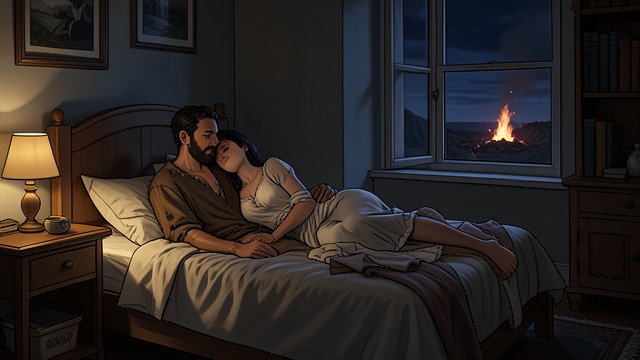
Death Accepted at Last
From Resistance to Surrender
Goldmund once fought fiercely to escape execution; now he accepts his weakening body with curiosity. Pain becomes inseparable from the image of his mother drawing him toward death.
A Final Relationship
Narcissus stays with him as he speaks about life, art, and the mother he will not carve. His death closes the road without resolving the metaphysical questions it raised.
During Goldmund’s first winter on the road
During Goldmund and Robert’s travels in the plague region
During the height of the Black Death
Near the end of summer in the forest shelter
In Goldmund’s final days at Mariabronn
